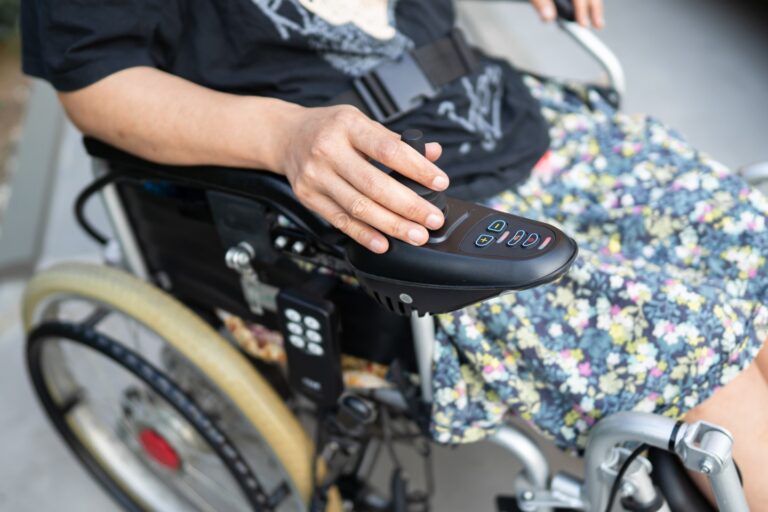
How to prepare for a flight when you have a spinal injury

Going abroad on holiday is something many people spend the whole year looking forward to and planning. But for many of our clients, navigating the first holiday after a spinal injury comes with a lot of worry.
There are certainly improvements needed to make aeroplanes more accessible, but I want people with accessibility needs to know there are things which can be done to make life a little easier.
Having grown up with family members who are wheelchair users, I’ve heard all too much about what needs improving, and I’ve also picked up some tips on how to prepare.
Holiday tips for people with accessibility needs
The first step is ensuring you book assistance for your flight, which should be done at least two days before you depart. Every airline and airport is slightly different, so be sure to check any specific requirements, and remember to book assistance for both leaving and coming back.
Almost every airline will require you to either be able to transfer independently into an airline seat or have someone with you who can assist. This is a matter of safety, and so whilst some airports and airlines will have trained staff who will be available to assist with getting on and off the plane, it is important to ensure you are either able to get in and out of your aeroplane seat yourself, or someone is with you who can help in case this is needed in an emergency. You can bring equipment with you to assist with this; just ensure you make the airline aware of what you are bringing and that it will need to be kept with you.
Airlines will also often require individuals to move into an aisle chair to get to their seat – unless you have your own chair which can fit down the aisle. Be prepared for this step in the journey.
Most airlines will also allow for extra luggage, for medical equipment, mobility aids and any other items you may need. A lot of airlines will also allow this to be taken free of charge or at a discount, so be sure to check this before travelling.
It is also always recommended to keep things like medication or equipment you may need in an emergency close by and in your hand luggage. Make sure you have enough with you (preferably extra) and it is accessible to you during the flight. Making a flight attendant aware of the bag it is in and the fact that you may require it during the flight is always a good idea.
Improving accessibility on planes
Whilst there are ways to prepare yourself for what to expect when flying with a spinal cord injury and not every experience is a negative one, there are most definitely ways in which the system needs improving.
I have heard first-hand about the many difficulties faced by my own family members on planes, and over the years, I have seen things go well but also wrong.
A lot of the changes airlines and airports can make to improve their services for those with mobility needs are very simple.
Based on my own family’s experience, here are a few ways in which airport and airline assistance could improve accessibility:
Ensuring those with accessibility needs are seated next to their family, friends or carers
This has been highlighted in my own family’s experience with booking flights. If a family member is not able to sit next to my aunt, she would have no way of putting her oxygen mask on in an emergency. She would also struggle to unwrap her food or water during the flight. This is not a matter of convenience but a matter of safety.
As soon as someone ticks the box to say they have accessibility needs and are bringing a carer/family member who can assist, airlines should ensure these passengers are sat together.
Allowing family members or carers to assist in transfers if required
Every single person is different, and so giving disabled people the choice as to who assists them onto the aircraft is so important for their comfort, autonomy and safety.
Multiple times on aircraft my family members have been told that, due to protocol, it is the staff who must assist with transfers. Whilst these staff members may have been trained, they are not medical professionals, nor do they know exactly what is required. There is no situation where they will understand how to safely transfer someone better than the person’s family or carers, who have been looking after them every day.
Unfortunately, I have seen that this has resulted in upset and injury, which is so easily avoidable. Often, after being told by staff that my aunt’s family are unable to assist with getting her onto the plane, my family has then been approached by staff again, asking for help and advice on how to safely get her into a plane seat, or even told to come on and do it.
More than just delaying everyone else getting onto the plane, this is very distressing and avoidable, and in most cases ends up with family members having to go and assist anyway.
Ensuring wheelchairs and mobility aids are handled with care and priority
Broken mobility aids from flights are more than just an inconvenience; it takes away someone’s ability to move. Proper staff training on how to handle the equipment, as well as ensuring they understand just how important these items are, would mitigate damage.
All three of these changes are fairly simple and inexpensive. Whilst many airports and airlines are doing a good job and not every experience is a negative one, there is still a way to go.
More information on accessible holidays
If you are looking to book a holiday abroad and have more questions about air travel with a spinal injury, the Spinal Injuries Association has a hub dedicated to air travel with more details on steps to take and what to expect.
Many mainstream holiday providers, such as TUI, also offer packages which are accessible and can assist with ensuring that adaptations, where needed, are put in place from the airport to the destination and home again.
At Bolt Burdon Kemp, we understand just how important access to leisure activities such as a holiday abroad can be for our clients. Helping them navigate these holidays and pushing for changes to systems to make this easier is something we understand and work towards.