Understanding prolonged disorders of consciousness and how legal claims can help

The impact of a catastrophic brain injury can be profound and long-lasting. In some cases, a person may not regain consciousness or awareness of themselves or their surroundings for some time. In medical terms, this is referred to as a Prolonged Disorder of Consciousness (often abbreviated to “PDOC”).
Understandably, this can be an incredibly distressing and confusing time for loved ones. Initial feelings of joy and relief that the person has survived can quickly be supplanted by a sense of fear and confusion when they don’t wake up and regain consciousness.
I have had the privilege of representing a number of clients who have been in a Persistent Disorder of Consciousness. Supporting both them and their loved ones has given me an invaluable insight into the medical, legal, emotional and practical challenges that arise when someone has a reduced level of consciousness and/or awareness.
Understanding what PDOC means, how it is assessed and what support may be available may shed some light on a dark period.
What is a Prolonged Disorder of Consciousness (“PDOC”)?
PDOC is a loss, or lack, of consciousness after a brain injury which has continued for at least four weeks.
This can happen as a result of any kind of brain injury, irrespective of the cause of that brain injury. Brain injuries arise from either:
- direct trauma or impact to the brain, which typically happens in car, motorcycle or bicycle accidents, through a fall or as the result of an assault, or
- from a medical cause, such as stroke or a period of hypoxia, which is when the brain is deprived of oxygen.
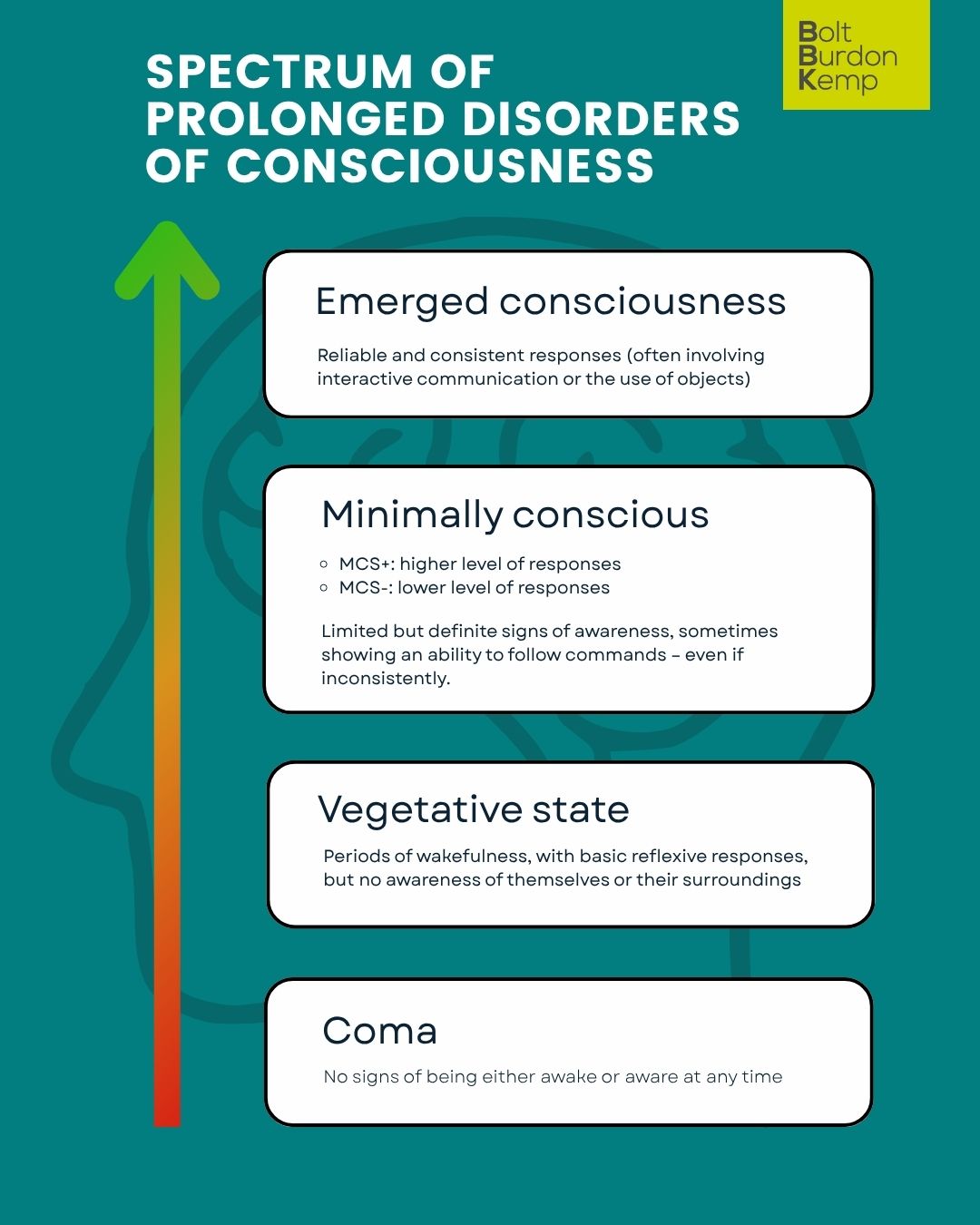
PDOC is an umbrella term that includes several states of consciousness, the most common being a coma, when the patient is in a vegetative state or is minimally conscious. Once someone comes out of PDOC, they’re often referred to as ‘having emerged’. This chart, from the Royal College of Physicians’ Prolonged disorders of consciousness following sudden onset brain injury National Clinical Guidelines, explains the stages further.
It may seem difficult to differentiate between a coma, a vegetative state, or a minimally conscious state, but there are clear differences between them.
A person in a coma shows no signs of being either awake or aware at any time.
A person in a vegetative state may seem awake, in that they may open their eyes or blink. It may also be obvious when they’re asleep. They may show basic reflexes, for example, flinching at noise or pain, but these responses are reflexive, rather than purposeful. Despite these signs, patients in a vegetative state are often assessed as having no signs of awareness of themselves or their environment. Patients who lack awareness are unable to understand or interact with their surroundings. They are thought to react by reflex only.
By contrast, someone in a minimally conscious state shows limited but definite signs of awareness. This might include responding to simple commands, such as squeezing a hand, following objects with their eyes, or even showing emotional responses, such as crying. These signs do not need to be consistently shown in order for a patient to be deemed to be in a minimally conscious state; it may be that they do them once a day, but what matters is that they can do them – even if inconsistently.
How is PDOC assessed?
Given the very subtle, but important, differences between the stages, assessing a PDOC patient is an essential yet complex process. This is because it will inform the individual patient’s bespoke rehabilitation programme. And the right rehabilitation will be key to helping the patient to fulfil their potential in terms of any recovery they are able to make.
Recovery after brain injury can be unpredictable, even for patients who aren’t in PDOC, and where even very minor signs of awareness can be significant. For that reason, evaluations must be carried out by dedicated teams with expertise in neurological rehabilitation and appropriate qualifications in assessing PDOC patients. Often, this will include a team of professionals, in addition to the patient’s core neurology team, including neuropsychologists, occupational therapists, speech and language therapists and physiotherapists.
There isn’t a single tool or test to diagnose a patient’s state of consciousness. The assessment will focus on the patient’s behaviours and how they react to various stimuli. Assessments are often undertaken over multiple sessions, looking at a range of factors. Tests may include observations on how a patient tracks objects with their eyes, changes their facial expressions when presented with different scenarios and moves or reacts to prompts. Because responses can be subtle and inconsistent, assessments are typically repeated over time and can last several days.
Tools such as the Wessex Head Injury Matrix (WHIM), Coma Recovery Scale-Revised (CSR-R) and/or SMART (Sensory Modality Assessment and Rehabilitation Technique) are all commonly used. MRI or CT scans can also assist in understanding the extent of the brain injury and in detecting vital signs of brain activity.
What does this mean for recovery?
It’s very difficult to predict the prognosis for PDOC patients, as this varies greatly. Factors which may affect recovery can include the severity of the original brain injury, age, overall health, how long the patient has been in PDOC and the nature and extent of specialist rehabilitation and treatment provided.
As with any brain injury, the care and support provided by loved ones cannot be underestimated. In brain injury generally, it is widely accepted that family involvement is an important factor in clinical outcomes. This is a point that has been reinforced to me time and time again by leading neurorehabilitation experts who have treated my clients. I am also privileged to see it in action, with the wonderful clients we represent, and their devoted families.
Some PDOC patients will progress from one stage to the next, although when this happens, it is likely to be a gradual process – sometimes over months or even years. I’ve represented several clients who’ve progressed from being in a coma to being minimally conscious. One of my clients has since emerged and is now able to live, almost entirely, independently. However, this will not be the case for everyone and some individuals may stay in a vegetative or minimally conscious state indefinitely.
For families, the uncertainty of recovery and long-term prognosis can, undoubtedly, be one of the most challenging aspects of caring for a loved one in PDOC.
How can a legal claim help?
A legal claim aims to secure compensation for the negligently injured person. The purpose of the compensation is tied to the principle of restitution, as far as possible, to put the injured person back in the position they would have been in had the negligence not happened. Of course, with severe injuries like these, compensation will never eradicate the devastation caused by a catastrophic brain injury or turn back the clock – however, it can provide a lifeline of specialist care, therapy and treatment and support in the darkest of times whilst also providing financial security for the future, and ensuring that a client’s complex needs will always be met.
Once the issue of liability has been resolved in a claim, and a defendant has accepted they are responsible for the client’s injuries, interim payments of compensation can be sought, pending the final resolution of the claim.
From my own experience as a specialist adult brain injury solicitor, no two clients are the same. However, the following items are typically claimed, both on an interim basis whilst the claim is ongoing and for the future:
- A period of intensive in-patient rehabilitation at a leading private neurorehabilitation centre which specialises in treating patients in PDOC
- A bespoke care and rehabilitation package after the patient is discharged home, including input from neurologists, neuropsychologists, neuropsychiatrists, speech and language therapists, occupational therapists, physiotherapists and assistive technology specialists
- A brain injury case manager, who will coordinate and oversee the smooth running of the care and rehabilitation package and ensure the professionals involved, together with the client and their family, work together towards common goals and in the best interests of the client
- Equipment and aids, to help improve the client’s quality of life and meet their care needs
- A vehicle, including a Wheelchair Accessible Vehicle (‘WAV’)
- Adaptations to accommodation or suitable rental accommodation, capable of meeting the client’s needs and facilitating the smooth running of their care and rehabilitation package
- Additional funding for activities and holidays, as needed
- Loss of earnings, benefits and pension
- Court of Protection Deputyship costs, to ensure compensation is managed in the client’s best interests.
Regrettably, due to funding constraints, access to bespoke care and rehabilitation packages which are appropriate for patients in PDOC can be challenging through the NHS. However, these can be readily accessed by clients in PDOC who have a legal claim.
Each client will have their own needs and goals for their future, and it is their solicitor’s job to identify and evidence those needs and make a compelling claim for an award of compensation that will meet them.
I represented a PDOC client whose main goal, after emerging from being in a minimally conscious state, was to walk their dog again. This has since been achieved with neurorehabilitation, which began in the UK and continued abroad.
For one client who has not yet emerged, the compensation we secured ensured that all their needs, for the remainder of their life, were funded. This included an inpatient intensive course of rehabilitation at a world-leading private neurorehabilitation centre. It also covered a specialist private therapy team and 24-hour nursing care after their discharge home. The compensation will fund suitable accommodation in the community. In this particular case, this allows for the rental of a new property adapted to meet the client’s needs, with appropriate space and layout for their care and rehabilitation package to run smoothly, with state-of-the-art equipment. The compensation also provided lifelong financial security to cover my client’s loss of earnings, up until their natural retirement age.
A legal claim can help fund the right assessments at the right time, carried out by suitably qualified clinicians. These assessments inform a bespoke programme of care and rehabilitation, which is key to maximising recovery and quality of life.
These assessments are imperative to a patient’s recovery. Without accurately establishing the patient’s stage of recovery, it is impossible to plan and coordinate an effective rehabilitation programme.
Even where full recovery is unlikely, rehabilitation can still make a meaningful difference. It can promote progress, manage complications, improve quality of life and provide comfort, whilst supporting independence and communication.
Interim payments of compensation can often be secured once liability is established, even before the claim is finally resolved. These payments help fund access to the specialist rehabilitation needed at an early stage.
Supporting families through a difficult time
Families of patients in PDOC often face immense emotional and practical challenges. Supporting a loved one in PDOC, whilst navigating complex medical information, care arrangements and legal processes can feel overwhelming.
Legal advice can be invaluable to families, guiding them through this process and ensuring that the injured person’s needs remain at the centre of any claim. While compensation cannot undo the effects of a catastrophic brain injury, it can provide vital resources for neurorehabilitation, a private care team and long-term support and, with that, peace of mind for the future.
Ipek Tugcu is a partner and Head of the Adult Brain Injury team at Bolt Burdon Kemp. A leader in the field and ranked in the Legal 500 and Chambers and Partners, she has consistently secured strong results for a number of clients in various stages of PDOC resulting from road traffic accidents, a fall from height at work and clinical negligence.